
Climate finance in Albania: the issue and the momentum for mobilization

Climate change is no longer an abstract risk for Albania. Floods, droughts, fires and infrastructure-related risks are occurring more frequently and at higher costs, while the “cost of inaction” translates every year into pressure on public budgets, local economies and household well-being. This raises a fundamental question for policymaking: do we only have strategies and objectives, or do we also have the financial capacity to translate them into concrete measures?
In this context, climate finance is the link that connects planning to results. Without financial instruments, clear priorities and structured projects for financing, national adaptation and mitigation plans risk remaining “good on paper” documents, but weak in implementation. For a country with high exposure to climate risks, the challenge is not only to identify what needs to be done, but to ensure how it will be financed, implemented and monitored.
Historically, climate policies in Albania have often been treated as part of the environmental agenda, while budgeting, investment prioritization and financial decision-making have followed a different logic. But climate risks are also economic, fiscal and financial risks: they affect public assets, basic services, business activity and the stability of public finances. This requires an approach where climate is introduced into the “language” of finance: investment portfolios, project standards, financial instruments and traceability of expenditure.
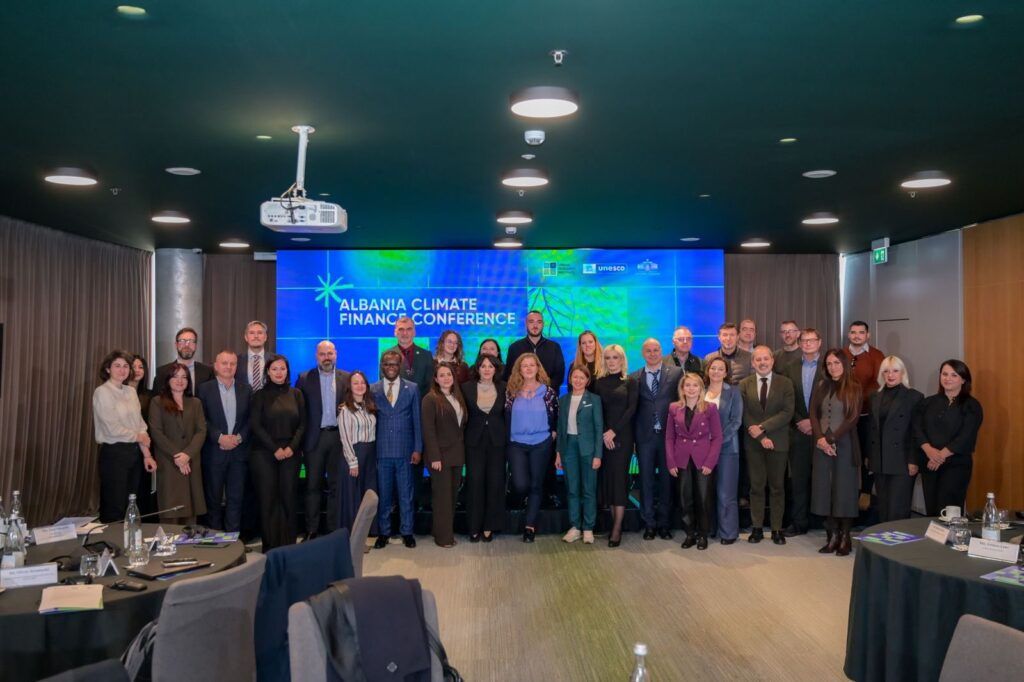
A clear signal of this transition was given with the National Climate Finance Conference, held in Tirana on 15 December 2025. It served as a meeting point where state institutions, financial authorities, development partners, experts, the private sector and academia focused on a practical question: how does climate policy translate into real, sustainable and measurable financing?
The conference was co-convened by the Ministry of Environment, the Urban Research Institute (URI) and the UNESCO Office in Venice, with a focus on accelerating financing for adaptation and sustainability, in line with Albania’s national priorities and international climate commitments. URI’s role in this process was integrated as a technical and facilitating role: guiding the discussion towards capacities, bankable projects and mechanisms that make climate finance financially viable.
From “fund-finding” to the full investment chain
One of the key messages that emerged is that climate finance is not simply about finding funds. It requires a full chain: from idea to concept, from design to implementation, from monitoring to impact reporting. Without this chain, even the best financial resources may not translate into results. This is where the need for project standardization, strengthening technical capacities and institutional coordination becomes critical.
Towards a National Climate Finance Platform
The discussions also highlighted the importance of a more unified coordination mechanism, such as the National Climate Finance Platform. Such a structure is valuable only if it creates function, not just form: if it links policies to the budget and investment portfolio, standardizes the way projects are prepared, establishes clarity on funding priorities and criteria, and strengthens reporting and traceability of climate spending.
The financial sector and the role of the Bank of Albania
The participation of the Bank of Albania raised the discussion from the level of projects to the level of financial stability and risk management. In its public communication, the Bank underlined the importance of climate and transition risks as a material source of vulnerability for the banking system and the economy, and referred to steps taken within the framework of its Green Strategy 2022–2025: establishing a working structure, developing monitoring indicators, exposure assessments and guidance for banks on environmental risk management.
Why is this directly related to EU integration
Climate and environment are increasingly a practical part of the European integration process: not only legal approximation, but also financed and measurable implementation. For the chapters related to the Green Agenda, the real challenge is the capacity to mobilize resources, to create viable projects and to guarantee institutional coordination and transparency.
What needs to happen next
If this momentum is to become a real turning point, three steps stand out:
- a structured portfolio of climate investments with projects ready for financing, especially for adaptation and resilience
- the integration of climate finance into fiscal planning and financial risk management policies
- the operationalisation of a functional coordination mechanism with a clear mandate, measurable role, and transparency
In this second phase, technical and bridging actors remain essential: helping translate dialogue into processes, processes into projects, and projects into investments. The core idea is simple: the green transition does not move forward on will and strategies alone, but on financial architecture, institutional coordination, and measurable investments.
=