
Elbasan towards climate neutrality: how the city is transforming through GreenELB and eCIM with URI support
In the Municipality of Elbasan, structured steps are being taken toward climate neutrality, grounded in data and pilot projects that propose solutions that can be implemented in practice. The Urban Research Institute is a partner in two projects that address, in an integrated way, the key sectors of Elbasan’s urban climate transition—energy efficiency in private buildings and alternative mobility—through the initiatives Green and Sustainable Energy in “Elbasan Buildings” (GreenELB) and Elbasan Climate-Neutral Innovation in Mobility (eCIM). The projects are implemented with the support of NetZeroCities for EU Mission cities for Climate Neutrality, reflecting two complementary phases of the urban transformation process. GreenELB is part of the Pilot Cities Programme, Cohort 3, and focuses on testing and piloting solutions to reduce energy consumption in private homes, while eCIM is implemented under Enabling City Transformation, aiming to create the institutional, regulatory, and financial conditions for developing and scaling alternatives for everyday mobility. Together, these projects support the shift from piloting to broader implementation, building capacities, mechanisms, and practices that make the climate transition part of day-to-day urban management in Elbasan.
Through these projects, Elbasan aims to move from linear planning toward an adaptive model of urban governance, where policies, investments, and infrastructure interventions are supported by cycles of testing, measurement, and continuous improvement. This model creates greater certainty for public decision-making and opens the way for integrating the climate transition into standard processes of urban planning and management.
Why are energy and mobility in focus?
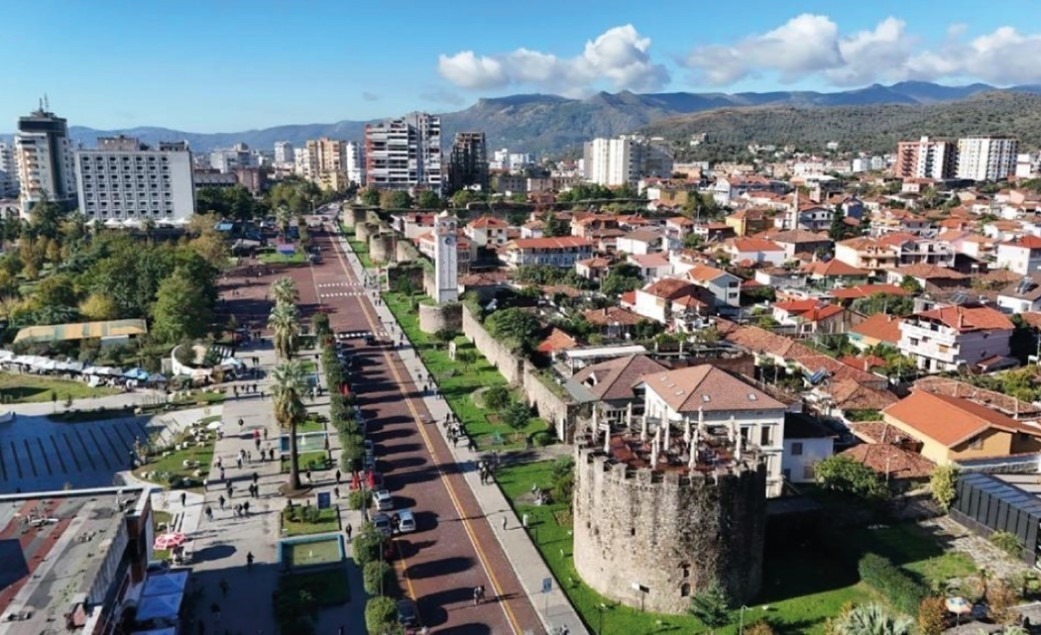
Elbasan is the third-largest city in Albania by population and a strategic hub in the centre of the country, positioned at the intersection of major national and European transport corridors. With an administrative territory of 872 km² that includes a compact urban core and a wide rural area, the city faces interconnected challenges related to urban development, mobility, and energy consumption. This territorial and functional context makes it essential to define sectoral priorities that directly affect emissions and everyday quality of life.
The emissions profile confirms this need. The first greenhouse gas inventory for 2023 for Elbasan shows that buildings and transport are the main sources of emissions in the city. In the buildings sector, energy consumption represents a significant share of total emissions, with 28.3% linked to electricity and 15.9% to non-electric energy. Within this sector, the main burden falls on private housing, which generates 96.8% of building-related emissions—mainly due to an ageing building stock, lack of insulation, and low energy efficiency.
At the same time, transport contributes 31.9% of the city’s total emissions. Over the past decade, the use of private vehicles has increased significantly, while walking and cycling have declined. This trend has been reinforced by an ageing vehicle fleet and limited infrastructure for active mobility, especially for bicycles. Traffic pressure is reflected not only in emissions, but also in road safety, air quality, and the use of public space in urban areas.
This reality places energy efficiency in buildings and alternative mobility at the centre of Elbasan’s vision for climate neutrality, as also reflected in the Climate City Contract. As one of the 112 selected cities in the EU Mission for Climate-Neutral and Smart Cities, Elbasan has identified these two sectors among the most important areas where interventions can produce faster and more tangible impact.
In this context, GreenELB focuses on reducing energy demand in private homes through structured energy-efficiency interventions, while eCIM addresses the transformation of how people move in the city, aiming for safer, cleaner, and more efficient alternatives for everyday travel. Together, these two projects represent not only a response to the current emissions profile, but also a strategic choice to improve urban quality of life and make the climate transition tangible for citizens.
GreenELB: How is energy demand being reduced in homes, starting with the Vullnetari neighbourhood?
GreenELB focuses on one of the largest sources of emissions in Elbasan: energy consumption in private homes. The project does not treat energy efficiency only as a technical issue, but as a combination of how homes are built and how energy is used every day by households. For this reason, GreenELB interventions are built simultaneously on technical data and on understanding residents’ behaviours.
The Vullnetari neighbourhood has been chosen as a pilot area because it represents many of the typical challenges of Elbasan’s residential stock: buildings constructed before modern insulation standards, high energy consumption, and everyday practices that often lead to inefficient energy use. This makes Vullnetari a suitable ground to test solutions that are practical and suitable for replication in other parts of the city.
How does GreenELB translate into concrete results for residential energy efficiency?
GreenELB starts by collecting clear information on how energy is used in homes, through energy audits and on-site assessments. In this framework, 20 pilot buildings in the Vullnetari neighbourhood have been selected and consulted for free energy audits, with the aim of building a measurable baseline for further interventions.
Based on this diagnosis, retrofit packages tailored to building typologies and real needs will be developed, along with a practical guide that makes the measures understandable and applicable. This includes developing building energy profiles and designing renovation solutions. The project also addresses the behavioural dimension of energy use, by testing simple, low-cost interventions aimed at improving everyday energy-use practices. In parallel, a regulatory testing approach for energy efficiency is being developed, so that the Municipality has a controlled space to test instruments and procedures before scaling them up.
An important component of GreenELB is youth engagement, in cooperation with the University of Elbasan and the Elbasan Student Council, who contribute to field assessments and to communicating sustainable solutions with the community. This approach connects the technical process with education, awareness-raising, and building a local culture of energy efficiency.
To ensure implementation and scaling over time, GreenELB develops a technical and financial plan by building local capacities through trainings and hands-on support for local actors, so that the methodology, assessment standards, and project planning and management skills for renovations remain within the city.
GreenELB is implemented from 01/09/2024 to 30/08/2026 and contributes to Elbasan’s transition toward climate neutrality, showing that change starts at home and through everyday practices.
eCIM: How is everyday mobility being transformed through a demonstrator corridor on Aqif Pasha Boulevard?
eCIM is a project focused on transforming urban mobility in the city of Elbasan, with interventions designed to be tested, measured, and improved, and to serve as a model for other interventions in this city and in other cities across the country. The key element is the creation of a demonstrator corridor on Aqif Pasha Boulevard, where interventions become visible, verifiable, measurable, and suitable for scaling.
What is being delivered together with the Municipality of Elbasan through eCIM?
eCIM is implemented in partnership with the Municipality of Elbasan and turns active mobility into a planned process, tested on the ground and supported by data. The project supports the drafting of a Detailed Local Plan that takes citizens’ needs into account and guides improvements in urban infrastructure, with the aim of making walking and cycling easier. The plan also proposes interventions in the road infrastructure of the central area to build an integrated and functional network of bicycle lanes, with clear priorities and network logic.
On the ground, a demonstrator corridor is being built and tested on Aqif Pasha Boulevard, where changes become visible and measurable before they are scaled up. In this context, a pop-up bicycle lane of around 1,000 metres is being piloted, accompanied by a measurement system and real-time data, to understand usage, behaviour, and the impact of the intervention. In parallel, safety and urban technology elements are being added, such as smart pedestrian crossings, bicycle counting systems, and monitoring components, to ensure continuous evidence on flows and how mobility changes.
To ensure these interventions do not remain only pilots, the project also strengthens how decision-making is coordinated within the city. Support is being provided for establishing an interdepartmental task force with more than 40 actors, including municipal structures and local stakeholders, to ensure coordination across planning, services, municipal police, education, communications, and the community. At the same time, a testing space for rules and instruments (“policy sandbox”) is being built, where the Municipality can trial standards, procedures, financing instruments, and procurement approaches—including green procurement and public-private partnerships—without exposing implementation to irreversible decisions.
Finally, eCIM invests in local capacity and a culture of measurement. Through trainings for municipal staff on climate budgeting, data interpretation, behavioural insights, and sustainable transport planning, as well as through the Mobility Students programme with the university, monitoring and data collection become part of everyday urban management practice.
eCIM runs from 01/04/2025 to 30/09/2026.
How do GreenELB and eCIM connect into a single transformation pathway?
GreenELB and eCIM share the same way of working—based on data, testing, measurement, procedures, and implementation capacities—applied in two areas: energy and mobility. In both cases, interventions are evidence-based. In GreenELB, audits and building energy profiles are used to understand consumption and savings potential, while in eCIM, flow measurements, counts, and corridor monitoring are used to analyse how the city moves. These data systems form the basis for informed decision-making and measurable interventions.
GreenELB and eCIM use a shared approach by testing policies and procedures before turning them into durable implementation. In GreenELB, this relates to instruments for energy efficiency and how retrofit is organised at municipal level, while in eCIM it relates to mobility rules, street-space management, procurement, and financing mechanisms.
The projects build capacity within the Municipality and among local actors, with a focus tailored to each sector. GreenELB strengthens skills for assessment, planning, and management of energy renovations, while eCIM focuses on mobility planning, data interpretation, cross-sector coordination, and building a monitoring practice.
Implementation is treated as a process that requires financing and procurement instruments, not only technical design. This makes pilots scalable. In practice, these two projects are helping Elbasan create a new working standard: evidence-based decisions, tested interventions, and institutional capacity that keeps momentum even after the projects end.
URI’s role and what is being left to the city
URI’s role in Elbasan is to connect analysis with implementation. In GreenELB, this translates into audit methodologies, retrofit packages, a technical and financial plan, regulatory testing instruments, trainings, and engagement models. In eCIM, this translates into pilot design, data structures, a mobility “policy sandbox,” trainings for municipal staff, a student programme, and support for coordination with stakeholders.
The intended outcome for Elbasan is clear: a working model that can be scaled up—with standards, procedures, data, capacities, and implementation instruments—so that the transition toward climate neutrality becomes a day-to-day practice of urban management.